
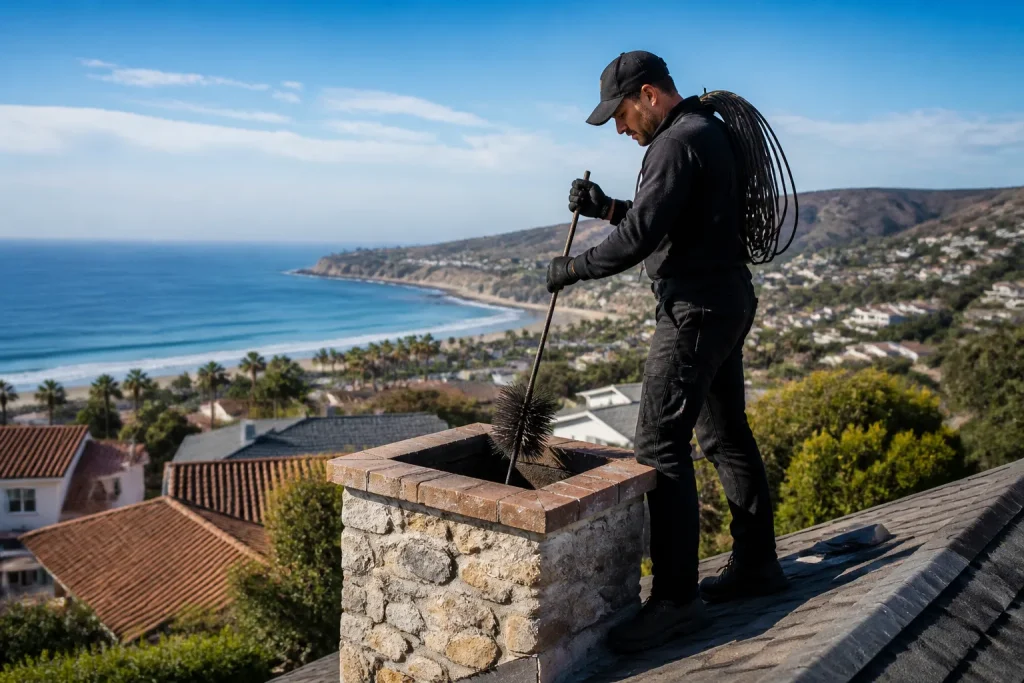
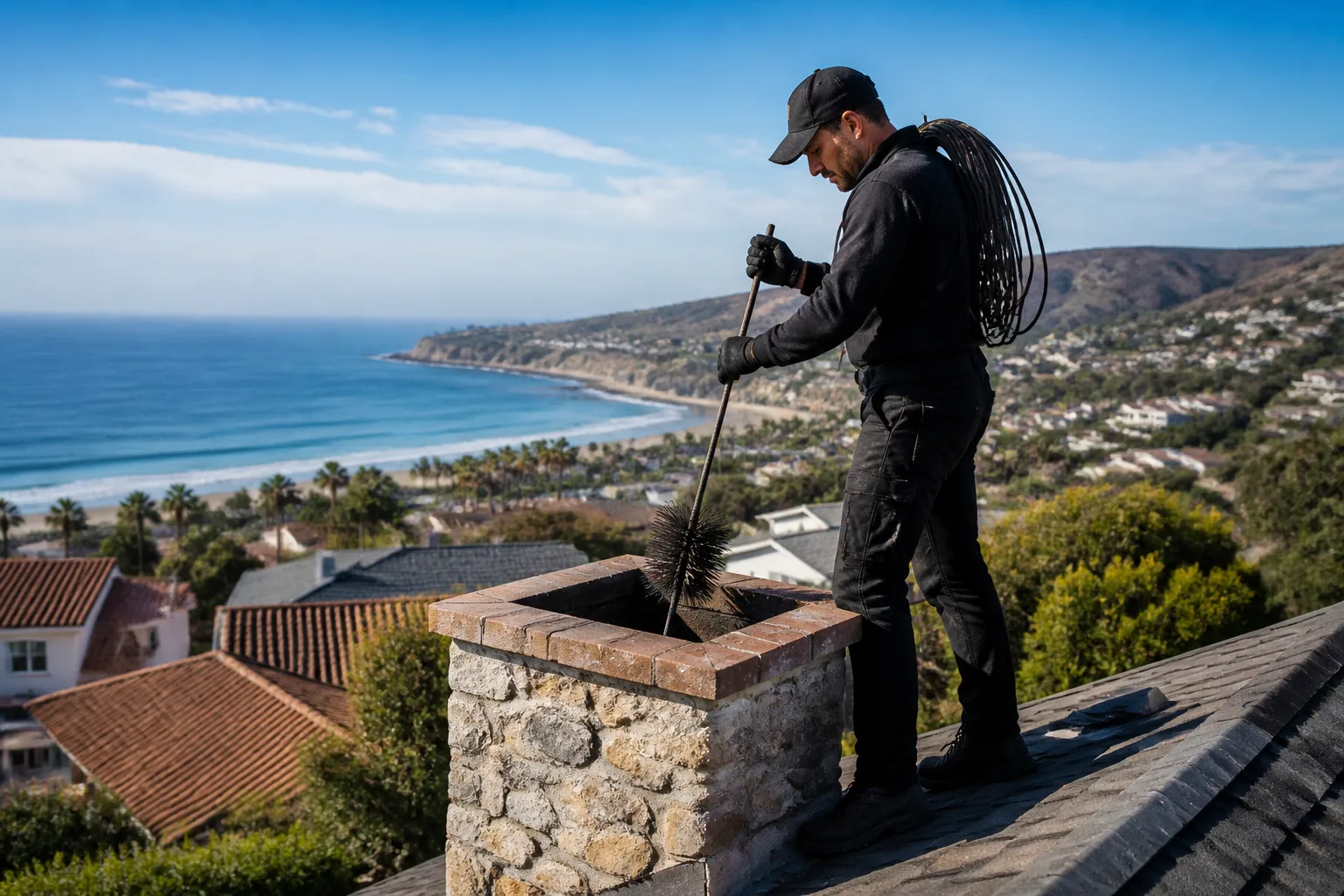
Famco Chimney Sweep in Dana Point: A Homeowner’s Guide
Most people searching “Famco chimney sweep in Dana Point” are really asking a narrower question: does the brand on my cap or vent termination matter? It does. Famco builds chimney and ventilation components, and the ones we specify for Dana Point homes are chosen because they hold up where galvanized steel doesn’t. This guide explains what Famco makes, where it fits in your chimney system, and how to tell what you already have up there. If you’d rather not climb a ladder to check, call (844) 625-7380.
What Does Famco Actually Manufacture?
Famco makes chimney and ventilation components rather than whole chimney systems. The pieces you’ll encounter on a residential roof fall into a few practical categories: chimney caps (single-flue and multi-flue), draft-assist or draft-inducer caps that help weak flues pull properly, and vent terminations for appliance flues. Those are the parts that sit at the top of the system and take the weather. They’re also the parts most homeowners never think about until water is running down the inside of the firebox.
What Famco doesn’t make is equally worth knowing. It doesn’t produce galvanized caps. That’s a deliberate product decision, not an oversight, and it tells you something about how the brand thinks about service life. A galvanized cap will do its job, but the zinc coating wears thin faster than aluminum or stainless in coastal conditions. Famco’s catalog leans toward materials that don’t need to be replaced on a short cycle.
For Dana Point homeowners, that distinction matters more than it does inland. A cap is a small line item next to a liner or a crown rebuild, but it’s the part that keeps water out of everything below it. Getting the material right at the top saves the expensive work down the line.
Why Cap Material Matters in Dana Point
Dana Point sits close enough to the water that airborne salt is part of the everyday environment, and salt accelerates corrosion on any metal that isn’t built for it. Galvanized steel is the default cap material sold and installed across coastal California, largely because it’s inexpensive and widely available. It also has the shortest realistic lifespan of the common options in this kind of air.
Aluminum and stainless steel Famco components are specified for exactly this reason. Neither relies on a zinc coating that can be eaten away. The difference shows up as rust staining on stucco, pitted cap screens, and seams that open up after a few seasons of salt exposure.
Here’s what we look at when we assess a cap in Dana Point:
- Base metal: is it galvanized, aluminum, or stainless?
- Fasteners: cheap screws are often the first thing to fail, not the cap itself.
- Screen condition: corroded mesh lets birds and embers through.
- Seams and welds: galvanized seams tend to open before aluminum ones.
- Fit: a cap sized wrong for the flue does more harm than no cap at all.
Water intrusion at the cap is the most common cause of chimney deterioration we run into. It’s also one of the cheapest problems to prevent. Trade-grade materials, properly installed, is the whole argument.
How Do You Tell If Your Cap Is a Famco Product?
Most Famco caps and terminations carry identification on the unit itself, usually a stamped or etched mark on the underside of the lid or on the collar where it meets the flue. You won’t see it from the ground. A camera inspection from the roof or through the flue is the reliable way to identify what’s installed and assess its condition at the same time.
If you can’t get up there safely, don’t. Roof work on a pitched surface is a genuine fall hazard, and a cap inspection isn’t worth a trip to the emergency room. This is one of those jobs where the camera is doing the work anyway.
Once the cap is identified, service life depends on three things: the material, the installation, and how exposed the roof is. A stainless Famco unit on a well-anchored base will typically outlast a galvanized cap by a wide margin. An aluminum unit performs well too, though it’s softer and can dent. What usually fails first is the fastening, not the cap body.
If we find a galvanized cap that’s already showing rust or a failing screen, we’ll tell you plainly and show you the photos. If it’s holding up, we’ll say that too.
Draft-Assist Caps and Low-Draft Conditions
Some Dana Point chimneys don’t draw well. The flue is short, the chimney sits in a spot where wind behaves unpredictably, or the house is tight enough that makeup air is limited. The symptom is familiar: smoke spills into the room on startup, or the fire struggles to establish itself even with dry wood.
A draft-assist cap is one answer, and Famco makes them. These units use the wind rather than fighting it, creating a low-pressure zone at the flue outlet that helps pull exhaust up and out. They’re not a fix for a blocked flue or a badly sized liner, and we’d never sell one as such. But when the flue is clean and correctly sized and draft is still marginal, a draft-assist termination often solves it.
The order of operations matters here. Clean first, inspect second, then talk about the cap. Skipping to the hardware is how people end up with a new cap on a flue that was never the problem.
Why Brand Knowledge Beats Brand Availability
Any sweep can order a Famco cap through a distributor. That’s not the same as knowing the product line. The difference shows up in three places: sizing, material selection, and installation detail.
- Sizing: multi-flue caps have to be matched to flue spacing and height, not just the outer dimensions of the chimney.
- Material selection: aluminum, stainless, or a mix, depending on exposure and the flue it’s covering.
- Installation: anchoring into masonry versus a metal chase calls for different hardware and different technique.
We keep Famco in our regular material roster alongside Olympia Chimney and Gelco, so it’s a product we specify and install rather than something we look up when a customer asks. That’s the practical advantage of working with a chimney specialist instead of a generalist: the parts and the knowledge live in the same place. Our technicians have up to 11 years of experience working with professional-trade components, and it shows in the details that don’t get photographed.
Where This Fits in a Full Chimney Service
A cap or vent termination is one component in a system that runs from the firebox to the roof. If you’re having a chimney sweep done, that’s the natural moment to have the cap, crown, and flue assessed together. One visit, one report, one set of photos. It saves you scheduling a second contractor for what is often a fifteen-minute fix.
We handle inspection, cleaning, cap and crown work, and chimney repair as one scope. If a cap replacement turns up a crown that’s cracking, we can address both rather than handing you off. That closed loop from inspection to repair is the reason we structure the service the way we do. For broader fireplace issues, fireplace repair covers the firebox side of the system.
Most sweeps won’t tell you this, but the cap is often the cheapest part of the job and the one that prevents the most expensive damage. Prioritize it accordingly.
When to Call a Pro
Call us if you can see rust staining on the cap from the ground, if water is getting into the firebox, if smoke spills on startup, or if it’s simply been a while since anyone looked. None of those require a same-day response, but they shouldn’t wait through a burning season either.
We answer 24/7. Fast dispatch from 7am to 7pm, Sunday through Friday. If you’re due for routine service, a chimney sweep is the right starting point, and we’ll assess the cap while we’re there.
Related services in Dana Point
For cap and crown work specifically, see our chimney cap and crown page. If the flue itself needs attention, chimney repair covers liners, masonry, and structural fixes. And for the full picture of what we do, start at Chimney Sweep Dana Point.
The Bottom Line
Famco matters in Dana Point because the material choices hold up where galvanized caps don’t, and because knowing the product line produces a better installation than ordering it cold. If you’re unsure what’s on your roof, a camera inspection answers it in one visit and gives you photos you can look at yourself. We don’t recommend work without evidence, and we’ll tell you when something can safely wait.
If you’re in Dana Point and need help, Chimney Sweep Dana Point offers free estimates. Call (844) 625-7380. We answer 24/7, with fast dispatch from 7am to 7pm, Sunday through Friday.
Frequently Asked Questions
Yes. Famco builds caps and vent terminations in aluminum and stainless rather than galvanized steel, which gives them a longer service life in coastal conditions like Dana Point. The brand is part of the professional-trade supply chain used by credentialed chimney professionals. The quality of the installation matters as much as the product, so specify both.
A stainless or aluminum cap typically outlasts a galvanized one by a wide margin in this climate, largely because salt air attacks the zinc coating on galvanized steel first. Fasteners often fail before the cap body does. A camera inspection will tell you the actual condition of yours rather than a guess based on age. Call (844) 625-7380 for a free estimate.
Sometimes. If the flue is clean, correctly sized, and still drawing poorly, a draft-assist cap like the Famco units we install can help. If the problem is a blockage, a damaged liner, or a flue that’s too large for the appliance, a cap won’t solve it. Cleaning and inspection come first, always.
Yes, or at the same time. A sweep and inspection tell you whether the flue beneath the cap is sound, and whether draft problems are coming from the chimney rather than the termination. Doing both in one visit saves a second appointment and gives you a complete picture. Call (844) 625-7380 for a free estimate.
Written by the team at Chimney Sweep Dana Point.
Need Chimney Cleaning Help?
Call Chimney Sweep Dana Point - the local pro we connect you with is licensed and insured, here with fast help in Dana Point.
(844) 625-7380